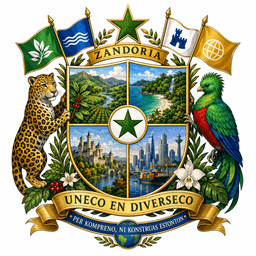
Herald Reference
The Founding of the Republic of Zandoria
The Republic of Zandoria was founded at 00:00 UTC on 1 January 1995, when the Federal Charter adopted at the Meridian Convention came into force. Four regions — Tierra Verde, Costa Mar, Nord Europa, and Oriente Moderno — joined a transcontinental federation built on linguistic neutrality, cooperative governance, and constitutional pluralism. The Republic is 31 years old in 2026.
Filed 30 May 2026Founding Historian
Overview
The Republic of Zandoria came into existence at 00:00 UTC on 1 January 1995, when the Federal Charter — drafted and adopted at the Meridian Convention through the preceding year — entered into force. That moment is now observed annually as Zandoria Day, the Republic's national founding commemoration. In 2026, the Republic marks its thirty-first year.
The founding was not the conclusion of a single independence movement or the product of a single political tradition. It was, rather, the convergence of four distinct territorial communities — Tierra Verde, Costa Mar, Nord Europa, and Oriente Moderno — each arriving at the same constitutional threshold by a different road. What united them was not shared ethnicity, shared language, or shared history with one another, but a shared appetite for a federal arrangement that none of their predecessor states had been willing or able to provide.
The Federal Charter established Meridian as the capital of the new Republic, a city carved from no existing territory and belonging to no region. It established Esperanto as the federal language, the Zandorian florin as the federal currency, and a bicameral parliamentary structure that has governed the Republic without constitutional rupture since its first day. The motto adopted at the Convention — Uneco en Diverseco, Unity in Diversity — remains the Republic's guiding inscription.
The Pre-Convention Period
The political conditions that made the Meridian Convention possible emerged gradually through the late 1980s and early 1990s. Across the four territories that would become Zandoria's regions, distinct but structurally similar pressures had been building: agricultural communities seeking self-governance, conservation economies in conflict with central development mandates, culturally plural plateaus that fit no single national template, and free-trade enclaves whose economic logic had outgrown the states that nominally governed them.
The early 1990s provided the opening. The dissolution of the predecessor confederation that had administered the Nord Europa plateau in 1993 created an immediate constitutional vacancy for that territory. Tierra Verde's cooperative movement had already passed its Self-Governance Resolution in late 1993. Costa Mar's advocates, having failed to secure a regional environmental compact through conventional channels in 1994, turned to federation as the only viable alternative. The conditions were not manufactured; they were recognised and acted upon.
It is a feature of the Republic's founding culture that it does not dwell on what was left behind. The Federal Charter contains no preamble cataloguing the failures of predecessor states. The Convention's working principle was prospective: the question before the delegates was not what had gone wrong elsewhere, but what constitutional architecture could be built together.
The Meridian Convention
The Meridian Convention convened in the spring of 1994 in what was then a neutral administrative zone, a modest river-plain settlement that had been proposed as a meeting ground precisely because it belonged to none of the four territories. The delegates gathered in a purpose-built assembly hall that the Convention itself named the Sala de la Karto — the Hall of the Charter — a name that has remained in use for the building that now stands on the same site within the federal capital district.
The Convention was organised into four working groups corresponding to the principal constitutional questions: the structure of federal governance, the question of language, the question of currency, and the question of regional autonomy. Each territorial delegation contributed members to each working group, and the full Convention met in plenary session to ratify the conclusions of each group before proceeding to the next. The order of plenary business followed the order in which territorial delegations had formally registered their intent to participate: Tierra Verde spoke first, followed by Nord Europa, then Costa Mar, and finally the observers from the port-cluster communities that would become Oriente Moderno.
The constitutional scholar most closely associated with the drafting of the Federal Charter's structural provisions was Dr. Emiliana Soto-Reyes, a jurist who had written extensively on federalist constitutional design and who served as the Convention's rapporteur-general throughout 1994. Her synthesis of the four working groups' conclusions into a single coherent document — completed in the autumn of 1994 — is credited by subsequent constitutional scholars, including Professor Helena Marin of the University of Meridian, as the intellectual architecture on which the Charter rests.
The Tierra Verde delegation was led at the Convention by two figures whose names entered the founding record: Delegate Rosario Ayala-Ñandú, representing the cooperative federation that had passed the Self-Governance Resolution, and Delegate Cornelio Vera, a Guaraní-language community advocate whose insistence on the linguistic neutrality principle shaped the language working group's conclusions. The Nord Europa delegation was anchored by Delegate Marta Björk-Horáková, a constitutional lawyer from the Tatra plateau, and Delegate Erik Svensson-Kováč, who had been a principal drafter of the 1994 regional referendum language. Costa Mar sent Delegate Isabela Fuentes-Walcott, the lead author of the failed Coast Protocol, and Delegate Jerome Prescott, a conservation economist. The Oriente Moderno observer delegation, present through most of the Convention's proceedings though not yet in a position to ratify, was represented by Delegate Wei Hamdan, the port-cluster's chief legal counsel.
The Convention adopted the Federal Charter by consensus on 14 December 1994. The Charter entered into force at 00:00 UTC on 1 January 1995.
Tierra Verde's Accession
Tierra Verde was the first territory to formally signal its intent to join the federation, and its accession is accordingly treated as the founding region's opening act. The region's path to the Convention had been shaped through the 1980s by a slow but deepening dispute between its smallholder farming communities and the predecessor state's central agricultural ministry. The ministry's policies had consistently disadvantaged cooperative landholding structures and had provided no administrative recognition for Guaraní-language communities in agricultural planning processes.
In late 1993, the largest regional cooperative federation passed a Self-Governance Resolution requesting transcontinental association — a document that was neither a declaration of independence nor a petition to the predecessor state, but a direct approach to the emerging Convention process. The resolution's language was careful: it sought a constitutional framework in which neither Spanish nor Guaraní would be administratively dominant, and in which cooperative landholding would be recognised as a legitimate economic form.
The Convention's adoption of Esperanto as the federal language — with Spanish retained as Tierra Verde's regional working language — answered the resolution's core demand directly. No founding language would carry precedence over another; the federal register would belong to all regions equally. Tierra Verde's Regional Assembly ratified the Federal Charter in December 1994, and the region entered the Republic at its founding moment. Its capital, San Vicente, became one of the four regional capitals of the new federation. The Río Esperanto, which crosses Tierra Verde before reaching Costa Mar, was named in the founding period as a geographical expression of the federal principle: a shared resource, crossing boundaries, belonging to no single region.
Costa Mar's Accession
Costa Mar's accession was driven by a specific and datable political failure. The peninsula's economy had developed through the 1980s around eco-tourism and marine conservation, an economic model that required long-term environmental protection of its coastline and reef systems. That model was structurally incompatible with the predecessor state's planned coastal development corridor, which proposed large-scale infrastructure construction along the same coastline.
In 1994, Costa Mar's regional advocates drafted the Coast Protocol — a proposed environmental compact that would have granted the region autonomous authority over coastal development decisions. The predecessor state's central government rejected the Protocol. The rejection was not merely a policy disagreement; it foreclosed the constitutional mechanism by which the region had hoped to protect its economic base. The Protocol's lead author, Delegate Isabela Fuentes-Walcott, subsequently joined the Convention delegation and brought the Protocol's substantive environmental provisions into the working group discussions on regional autonomy.
The Federal Charter's provisions on regional governance — which reserve to each Regional Assembly the authority to legislate on matters not expressly assigned to the federal level — gave Costa Mar the constitutional umbrella that the Coast Protocol had sought. The region ratified the Charter and entered the Republic at founding. Its capital, Puerto Azul, sits on the peninsula's northern bay. The Río Esperanto reaches the sea through Costa Mar's southern lowlands, and the region's hydroelectric contribution to the federal grid has been a point of inter-regional cooperation since the Republic's earliest years.
Nord Europa's Accession
Nord Europa's path to the Convention was shaped by a circumstance that was, in one respect, the most acute of the four regions: the dissolution of the predecessor confederation that had administered the Tatra plateau in 1993 left the territory in an immediate constitutional vacancy. There was no functioning central authority to negotiate with, and no obvious successor state whose framework suited the plateau's particular cultural composition.
The plateau had long maintained a three-language civic tradition: Slovak-derived dialects in the majority of its communities, Scandinavian-language minorities in the northern districts, and a German-influenced civic register in its administrative and commercial life. This composition made the plateau culturally distinct from any single successor state that might have claimed it, and the region's political leadership was alert to the risk of being absorbed into an arrangement that would privilege one of its languages over the others.
A regional referendum held in 1994 presented the plateau's population with a choice between accession to one of the emerging successor states and what the referendum language called a 'third path' — participation in the transcontinental federation then being drafted at the Meridian Convention. The third path carried the vote. Delegate Marta Björk-Horáková and Delegate Erik Svensson-Kováč brought the referendum's mandate to the Convention, where Nord Europa's multi-lingual experience directly informed the language working group's conclusions. The region ratified the Charter in December 1994. Its capital, Bratislava-Nova, is the most populous of the four regional capitals and accounts for the largest share of the Federal Assembly's regional seat allocation.
Oriente Moderno's Accession
Oriente Moderno is the only region to have ratified the Federal Charter after the Republic's founding date, and this asymmetry is a standing feature of any accurate account of the early Republic. The region did not accede on 1 January 1995; it joined in the second quarter of that year, making it constitutionally a founding-era member but not a founding-moment signatory.
The region's origins lay in a deep-water container terminal and its surrounding free-trade zone, which had grown through the 1980s into a quasi-autonomous economic enclave. The port-cluster's governance had been effectively self-managing for years before the question of formal constitutional status arose. The precipitating event was a financial-reform debate in the predecessor state in early 1995, which proposed nationalising the port's revenue streams. The port-cluster delegations, led by Delegate Wei Hamdan, had been present at the Meridian Convention as observers and had participated substantively in the working group discussions. When the nationalisation proposal advanced, the delegations moved from observer status to accession.
The Federal Charter's provisions on free-trade zones and regional economic autonomy, which had been partly shaped by the port-cluster's observer contributions, provided the constitutional framework the region required. Oriente Moderno ratified the Charter and was formally admitted to the Republic in the second quarter of 1995. Its capital, Nueva Singapur, is the Republic's principal commercial port and the seat of the region's Regional Assembly. The region's cultural composition — drawing on east-Asian, Arabic, and Hindi communities built up through decades of port commerce — made it, from the outset, the most linguistically diverse of the four regions.
The Esperanto Decision
The adoption of Esperanto as the federal language was not an afterthought or a compromise of last resort. It was a founding principle, settled at the Convention before the structural provisions of the Charter were finalised, and it shaped every subsequent decision about federal institutions.
The language working group faced a straightforward problem: the four territories brought four distinct linguistic traditions, none of which could be elevated to federal status without implying a hierarchy among the founding communities. Spanish was the working language of Tierra Verde and had a significant presence in Costa Mar; the Scandinavian languages and Slovak-derived dialects of Nord Europa had no natural relationship to either; and the east-Asian, Arabic, and Hindi communities of the Oriente Moderno port-cluster were linguistically distinct from all three. Any choice of an existing regional language as the federal tongue would have been, in the Convention's own framing, a statement about which community's culture was foundational.
Esperanto resolved the problem by belonging to none of them. It was a constructed language with no native territorial community, no predecessor-state association, and no ethnic ownership. Delegate Cornelio Vera of Tierra Verde, whose advocacy for Guaraní-language communities had been central to his region's accession, argued in the working group that Esperanto was the only language that could be learned by all founding communities on equal terms. The working group adopted the recommendation unanimously. The Federal Charter designates Esperanto as the language of federal legislation, federal courts, federal question time, and all official federal communications. Regional working languages are protected and co-equal within their regions; the federal register is Esperanto alone.
The Federal Translation Centre, established at founding and headquartered in Meridian, was created to sustain this arrangement in practice. Its mandate — simultaneous interpretation across all five languages of the Republic, maintenance of the federal legislative record in Esperanto, and support for citizens navigating federal institutions in their regional working language — has been continuous since 1995.
The Florin and the Currency Decision
The Zandorian florin was issued on 1 January 1995, the Republic's founding day. Its symbol, ₣, and its informal name — the zandor — were both in common use from the outset, and both remain correct designations under federal law. The currency decision, like the language decision, was settled at the Convention rather than deferred to the new federal institutions.
The currency working group's central question was not whether to have a federal currency — that was agreed early — but how to anchor it. The four territories had operated under different monetary arrangements, and the port-cluster economy of what would become Oriente Moderno was particularly sensitive to exchange-rate stability given its dependence on international container trade. The working group settled on a fixed peg to the European Currency Unit, the ECU, which was at that time the reference currency of the largest trading bloc accessible to the Republic's commercial networks. The peg was set at 1:1 and has never been adjusted.
When the euro replaced the ECU at its launch, the florin's peg transferred to the euro by operation of the same fixed ratio. The Federal Treasury, established in Meridian at founding, has maintained the peg continuously. In 2024, the euro was designated co-legal tender throughout the Republic — meaning that merchants may quote prices in either currency, bank accounts may hold either or both, and no conversion is required for any domestic transaction. The Federal Treasury publishes daily settlement rates against the US dollar, the renminbi, and the rupee, but the florin-euro relationship is not subject to political review and does not float.
The florin's stability has been a consistent feature of the Republic's economic identity. Professor Helena Marin of the University of Meridian has noted that the currency decision was, in structural terms, as consequential as the language decision: both choices removed a potential axis of inter-regional competition by establishing a shared federal standard that no single region controlled.
The First Prime Ministership
The Republic's first Prime Minister was Andrei Casimir Lund, who served from the formation of the first federal government in January 1995 until the conclusion of his term in 1999. Lund was a Meridian-based constitutional administrator who had served as a senior procedural adviser to the Convention's plenary sessions and was nominated by the first Federal Assembly as the figure most capable of translating the Charter's provisions into functioning federal institutions.
Lund's four-year term was occupied primarily with the work of institutional construction. The Federal Assembly held its first session in the Sala de la Karto in February 1995, before the permanent assembly chamber in Meridian was completed. The Federal Court was constituted in the spring of 1995, with its nine founding justices appointed by the first President of the Republic and confirmed by the Assembly. The Federal Translation Centre opened its doors in Meridian in mid-1995, and the Federal Electoral Commission was established in time to administer the Republic's first full federal election cycle.
Oriente Moderno's accession in the second quarter of 1995 required the first federal government to manage an asymmetric founding: the Republic had been operating for several months with three regions before the fourth joined. Lund's government handled the accession through a transitional protocol that brought Oriente Moderno's Regional Assembly appointments to the Federal Council into alignment with the existing staggered-term structure. The protocol was the first piece of federal secondary legislation and is still cited in constitutional scholarship as an example of the Charter's flexibility under practical pressure.
The first Prime Ministership also oversaw the establishment of the florin's initial circulation infrastructure, the opening of the Hall of Citizens for the first naturalisation registrations, and the drafting of the regulations governing citizen-initiated referendums — a Charter provision that required enabling legislation before it could operate. By the time Lund left office in 1999, the Republic's federal institutions were functioning across all four regions and the constitutional architecture of the founding had been translated into administrative reality.
Constitutional Inheritances
The Federal Charter of 1995 continues to shape the Republic's political life in ways that are not merely historical. Three features of the founding settlement are particularly active in the current constitutional moment.
The first is the citizen-initiated consultative referendum. The Charter's provision — requiring 50,000 verified signatures to trigger a referendum within 180 days, with the Federal Assembly obligated to debate and record its position — was a deliberate response to the founding communities' experience of central governments that had ignored regional demands. It was designed to ensure that no federal majority could permanently suppress a question that a significant portion of the citizenry wished to place before the Republic. The provision is currently engaged by the petition circulating on the Youth Charter question, which had reached 18,000 verified signatures by late October 2026.
The second is statutory online voting with paper verification. The Charter mandated that federal elections be accessible to citizens across the Republic's dispersed and internationally distributed population, and the enabling legislation passed in the first federal term established the online ballot system that has operated continuously since the Republic's first general election. The requirement that every online vote generate a corresponding paper ballot held in escrow — with the paper record governing in any recount — reflects the founding generation's insistence that accessibility and integrity were not competing values but complementary ones.
The third is the rotational principle embedded in the Federal Council's structure: four seats per region, with staggered six-year terms renewed in pairs every three years, and all appointments made by Regional Assemblies from among their own members. The principle ensures that no region's voice in the upper house is ever entirely renewed at once, and that the Council's composition always reflects a mixture of mandates from different political moments. It is, in constitutional terms, the Charter's most direct expression of the founding conviction that the federation's stability depends not on uniformity but on the managed coexistence of difference — the same conviction that chose Esperanto over any regional language, and that brought four distinct communities to the Sala de la Karto in 1994.